Question 12:
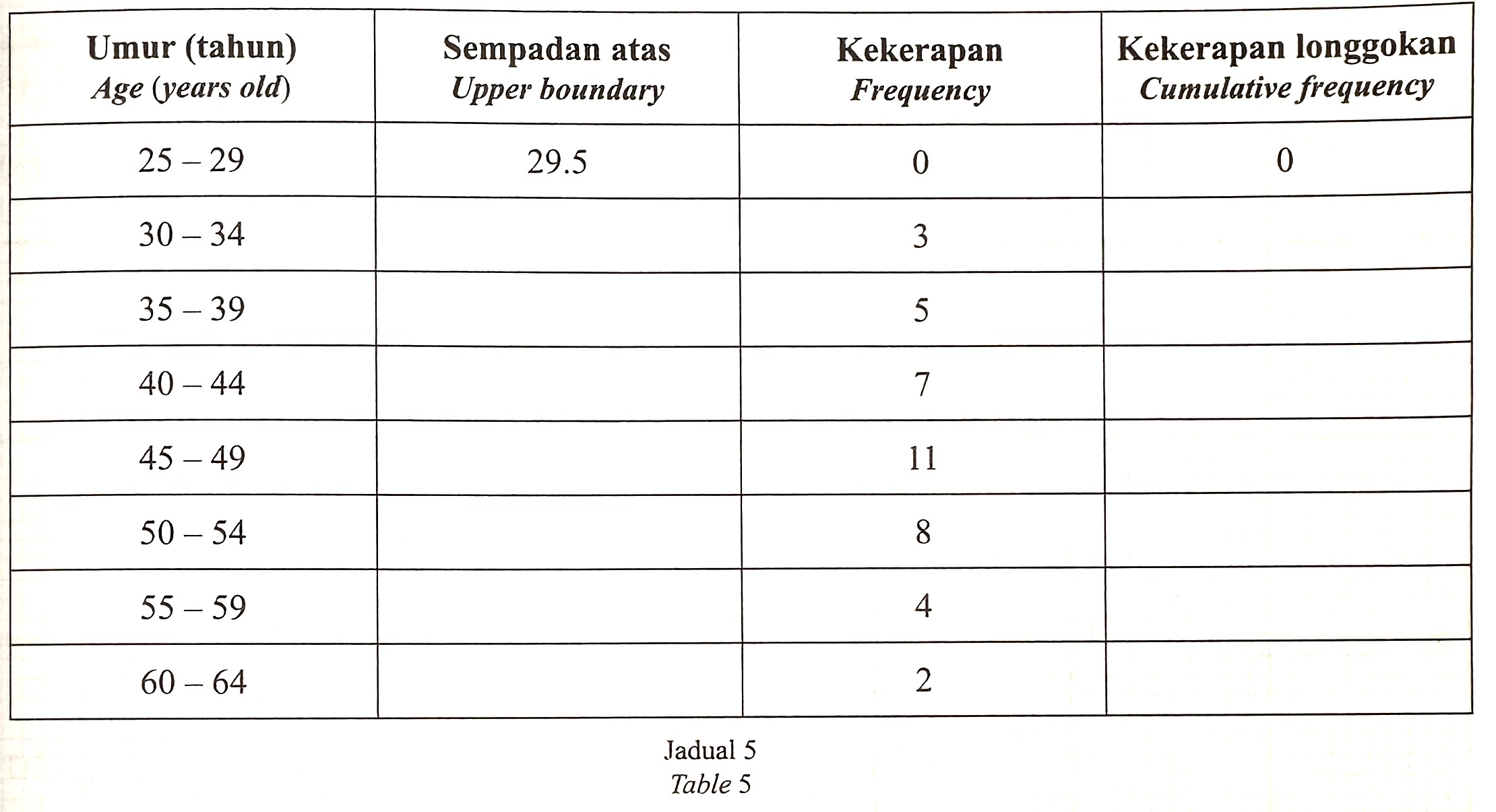
Table 5 in the answer space shows the age distribution of 40 visitors to a hot spring on a particular day.
(a) Complete Table 5 in the answer space.
[3 marks]
Answer:
You must use BB or 2B pencils to answer this question.
(b) For this part of the question, use the graph paper provided on page 156.
Using a scale of 2 cm to 5 years on the horizontal axis and 2 cm to 5 visitors on the vertical axis, draw a cumulative histogram for the data. [4 marks]
(c)(i) On the graph in (b), draw an ogive. You may use a flexible curve rule. [1 mark]
(ii) Only visitors at the 70th percentile and above will be given a drink voucher.
Find the minimum age required to get the voucher.
[2 marks]
Answer:
(a)
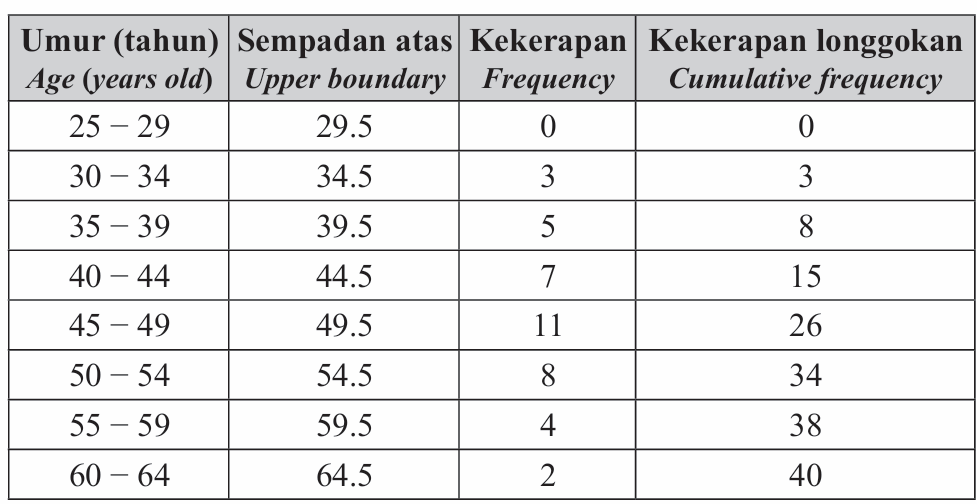
(b), (c)(i)
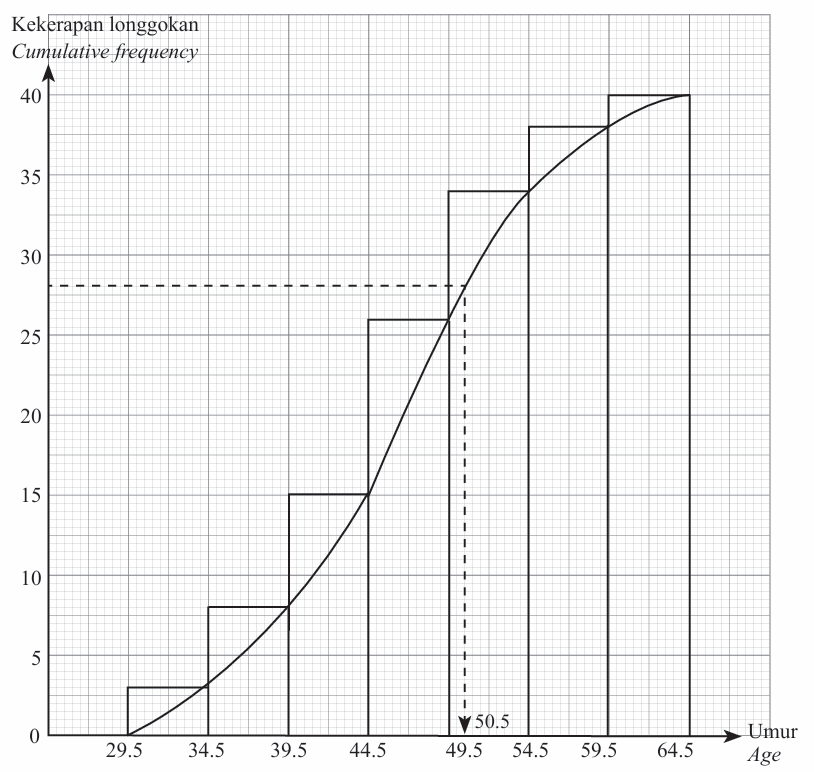
(b) Both axes are drawn in the correct direction with a uniform scale for 29.5 x 64.5 and 0 y 40.
Seven bars are drawn correctly using the boundary values.
Cumulative histogram is drawn correctly using the given scale.
(c)(i) The ogive is correctly drawn on the cumulative histogram.
(c)(ii)
$$ \begin{aligned} &\text { 70% of the total frequency }\\ &\begin{aligned} & =\frac{70}{100} \times 40 \\ & =28 \end{aligned} \end{aligned} $$
P70 = 50.5. The minimum age of visitors eligible to receive a drink voucher is 50.5.
Table 5 in the answer space shows the age distribution of 40 visitors to a hot spring on a particular day.
(a) Complete Table 5 in the answer space.
[3 marks]
Answer:
You must use BB or 2B pencils to answer this question.
(b) For this part of the question, use the graph paper provided on page 156.
Using a scale of 2 cm to 5 years on the horizontal axis and 2 cm to 5 visitors on the vertical axis, draw a cumulative histogram for the data. [4 marks]
(c)(i) On the graph in (b), draw an ogive. You may use a flexible curve rule. [1 mark]
(ii) Only visitors at the 70th percentile and above will be given a drink voucher.
Find the minimum age required to get the voucher.
[2 marks]
Answer:
(a)
(b), (c)(i)
(b) Both axes are drawn in the correct direction with a uniform scale for 29.5 x 64.5 and 0 y 40.
Seven bars are drawn correctly using the boundary values.
Cumulative histogram is drawn correctly using the given scale.
(c)(i) The ogive is correctly drawn on the cumulative histogram.
(c)(ii)
$$ \begin{aligned} &\text { 70% of the total frequency }\\ &\begin{aligned} & =\frac{70}{100} \times 40 \\ & =28 \end{aligned} \end{aligned} $$
P70 = 50.5. The minimum age of visitors eligible to receive a drink voucher is 50.5.
Question 13:
(a)
$$ \text { It is given that matrix } P=\left[\begin{array}{rr} 2 & 0 \\ -1 & 3 \\ 6 & -4 \end{array}\right] $$
(i) State the order of matrix P.
[1 mark]
(ii) $$ \text { Cari nilai } P_{22}+P_{31} \text {. } $$
(b) Toilets in a school have either big tanks or small tanks. Diagram 8 shows the number of water tanks in male and female toilets in a school.
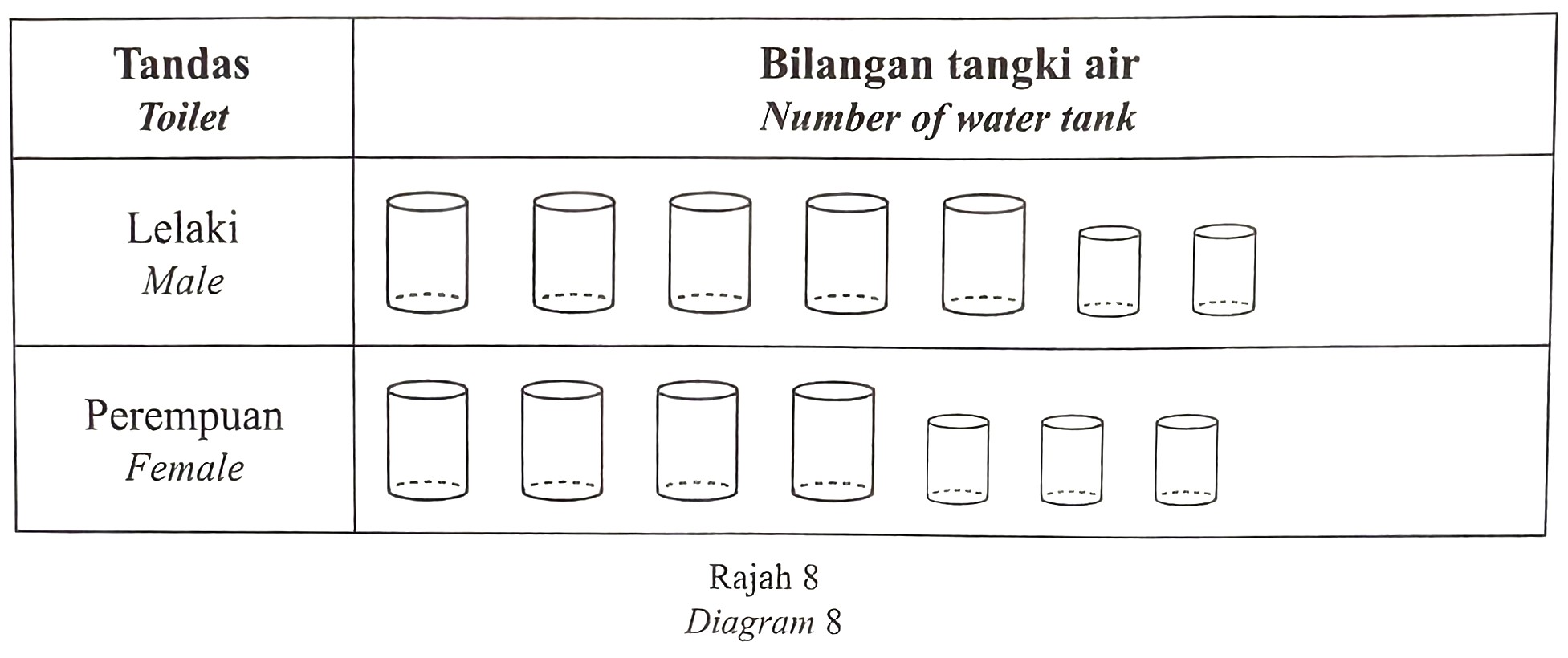
The total volume of water in a male toilet is 5320 l. The total volume of water in female toilet is 280 l less than the male toilet.
(i) Using the matrix method, find the volume of water, in l, of a big tank and of a small tank. [5 marks]
(ii) The school plans to add 2 big tanks and a few small tanks to store 3000 l of water: Using matrix multiplication, determine the minimum number of small tanks required. [2 marks]
Answer:
(a)(i) 3 × 2
(a)(ii) $$ \begin{aligned} P_{22}+P_{31} & =3+6 \\ & =9 \end{aligned} $$
(b)(i)
$$ \begin{aligned} 5 x+2 y=5320 \quad, \quad 4 x+3 y=5040 \\ {\left[\begin{array}{ll} 5 & 2 \\ 4 & 3 \end{array}\right]\left[\begin{array}{l} x \\ y \end{array}\right]=\left[\begin{array}{ll} 5 & 320 \\ 5 & 040 \end{array}\right] } \\ {\left[\begin{array}{l} x \\ y \end{array}\right]=\frac{1}{(5)(3)-(2)(4)}\left[\begin{array}{cc} 3 & -2 \\ -4 & 5 \end{array}\right]=\frac{1}{7}\left[\begin{array}{ll} 5 & 320 \\ 5 & 040 \end{array}\right] } \\ {\left[\begin{array}{l} x \\ y \end{array}\right]=\frac{1}{7}\left[\begin{array}{ll} 5 & 880 \\ 3 & 920 \end{array}\right] } \\ {\left[\begin{array}{l} x \\ y \end{array}\right]=\left[\begin{array}{l} 840 \\ 560 \end{array}\right] } \\ x=840 \\ y=560 \end{aligned} $$
(b)(ii)
$$ \begin{aligned} {[2 x]\left[\begin{array}{l} 840 \\ 560 \end{array}\right] } & =3000 \\ {[(2 \times 840+(x \times 560)]} & =3000 \\ 1680+560 x & =3000 \\ 560 x & =3000-1680 \\ 560 x & =1320 \\ x & =1320 \div 560 \\ x & =2.357 \approx 3 \end{aligned} $$
The minimum number of small tanks required is 3.
(a)
$$ \text { It is given that matrix } P=\left[\begin{array}{rr} 2 & 0 \\ -1 & 3 \\ 6 & -4 \end{array}\right] $$
(i) State the order of matrix P.
[1 mark]
(ii) $$ \text { Cari nilai } P_{22}+P_{31} \text {. } $$
(b) Toilets in a school have either big tanks or small tanks. Diagram 8 shows the number of water tanks in male and female toilets in a school.
The total volume of water in a male toilet is 5320 l. The total volume of water in female toilet is 280 l less than the male toilet.
(i) Using the matrix method, find the volume of water, in l, of a big tank and of a small tank. [5 marks]
(ii) The school plans to add 2 big tanks and a few small tanks to store 3000 l of water: Using matrix multiplication, determine the minimum number of small tanks required. [2 marks]
Answer:
(a)(i) 3 × 2
(a)(ii) $$ \begin{aligned} P_{22}+P_{31} & =3+6 \\ & =9 \end{aligned} $$
(b)(i)
$$ \begin{aligned} 5 x+2 y=5320 \quad, \quad 4 x+3 y=5040 \\ {\left[\begin{array}{ll} 5 & 2 \\ 4 & 3 \end{array}\right]\left[\begin{array}{l} x \\ y \end{array}\right]=\left[\begin{array}{ll} 5 & 320 \\ 5 & 040 \end{array}\right] } \\ {\left[\begin{array}{l} x \\ y \end{array}\right]=\frac{1}{(5)(3)-(2)(4)}\left[\begin{array}{cc} 3 & -2 \\ -4 & 5 \end{array}\right]=\frac{1}{7}\left[\begin{array}{ll} 5 & 320 \\ 5 & 040 \end{array}\right] } \\ {\left[\begin{array}{l} x \\ y \end{array}\right]=\frac{1}{7}\left[\begin{array}{ll} 5 & 880 \\ 3 & 920 \end{array}\right] } \\ {\left[\begin{array}{l} x \\ y \end{array}\right]=\left[\begin{array}{l} 840 \\ 560 \end{array}\right] } \\ x=840 \\ y=560 \end{aligned} $$
(b)(ii)
$$ \begin{aligned} {[2 x]\left[\begin{array}{l} 840 \\ 560 \end{array}\right] } & =3000 \\ {[(2 \times 840+(x \times 560)]} & =3000 \\ 1680+560 x & =3000 \\ 560 x & =3000-1680 \\ 560 x & =1320 \\ x & =1320 \div 560 \\ x & =2.357 \approx 3 \end{aligned} $$
The minimum number of small tanks required is 3.