Question 9:
Diagram 1 shows the information of properties owned by Muthu and Halim in the same town.
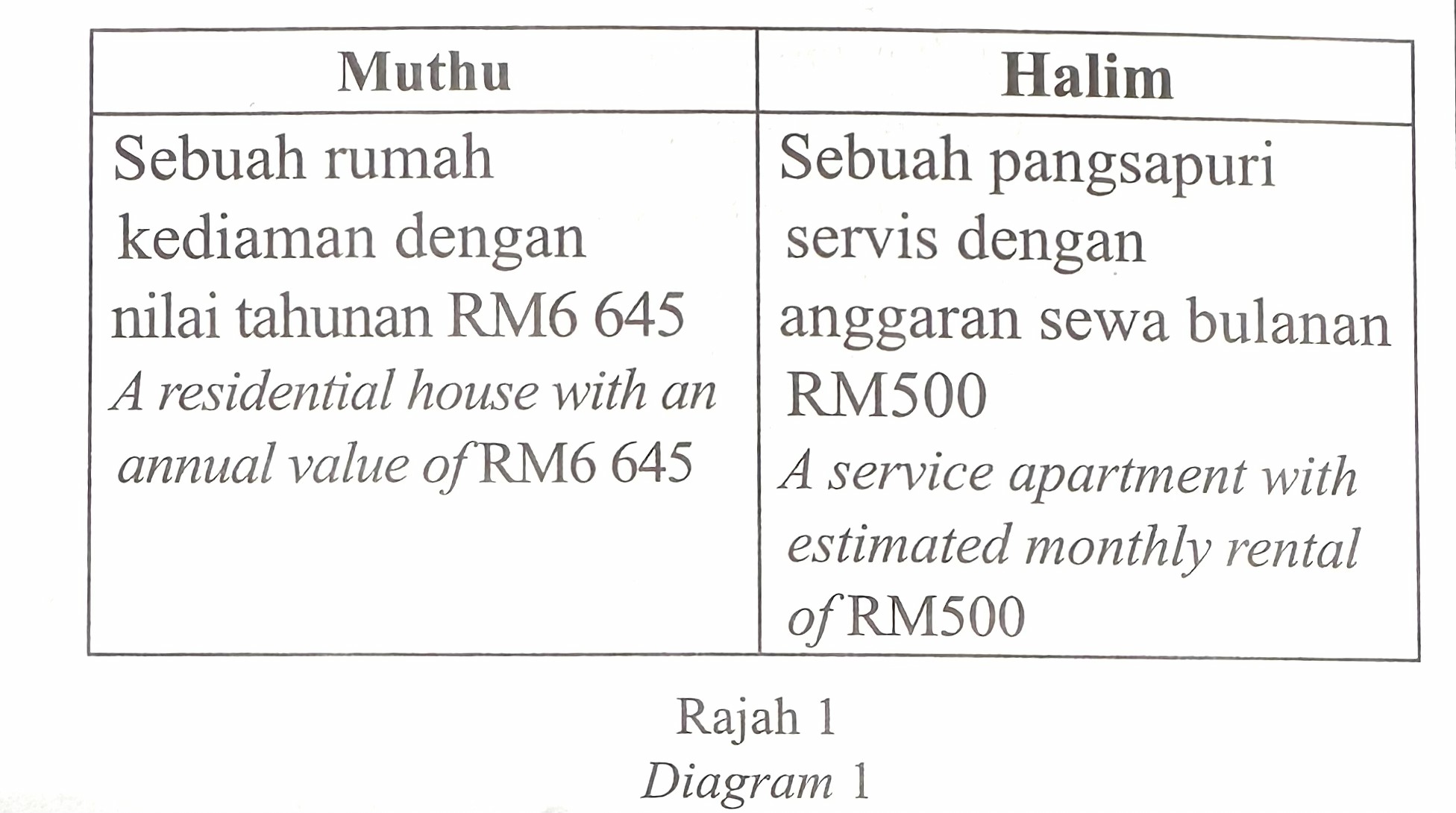 It is given that the property assessment tax rate is 5%.
Calculate the difference of the property assessment tax payable by Muthu and Halim each year.
$$ \begin{aligned} &\text { A RM29.77 }\\ &\text { B RM32.25 }\\ &\text { C RM52.69 }\\ &\text { D RM53.75 } \end{aligned} $$
Solution:
Answer : B
$$ \begin{aligned} &\text { Muthu’s annual property assessment tax }\\ &\begin{aligned} & =\frac{5}{100} \times \text { RM6 } 645 \\ & =\text { RM332.25 } \end{aligned} \end{aligned} $$
$$ \begin{aligned} &\text { Halim’s annual property assessment tax }\\ &\begin{aligned} & =\frac{5}{100} \times 12 \times \mathrm{RM} 500 \\ & =\mathrm{RM} 300.00 \end{aligned} \end{aligned} $$
$$ \begin{aligned} &\text { The difference of the property assessment tax payable by Muthu and Halim each year }\\ &\begin{aligned} & =\mathrm{RM} 332.25-\mathrm{RM} 300.00 \\ & =\mathrm{RM} 32.25 \end{aligned} \end{aligned} $$
Diagram 1 shows the information of properties owned by Muthu and Halim in the same town.
It is given that the property assessment tax rate is 5%.Calculate the difference of the property assessment tax payable by Muthu and Halim each year.
$$ \begin{aligned} &\text { A RM29.77 }\\ &\text { B RM32.25 }\\ &\text { C RM52.69 }\\ &\text { D RM53.75 } \end{aligned} $$
Solution:
Answer : B
$$ \begin{aligned} &\text { Muthu’s annual property assessment tax }\\ &\begin{aligned} & =\frac{5}{100} \times \text { RM6 } 645 \\ & =\text { RM332.25 } \end{aligned} \end{aligned} $$
$$ \begin{aligned} &\text { Halim’s annual property assessment tax }\\ &\begin{aligned} & =\frac{5}{100} \times 12 \times \mathrm{RM} 500 \\ & =\mathrm{RM} 300.00 \end{aligned} \end{aligned} $$
$$ \begin{aligned} &\text { The difference of the property assessment tax payable by Muthu and Halim each year }\\ &\begin{aligned} & =\mathrm{RM} 332.25-\mathrm{RM} 300.00 \\ & =\mathrm{RM} 32.25 \end{aligned} \end{aligned} $$
Question 10:
$$ \text { Given that } \frac{6-2 x}{3}=4 x \text {, find the value of } x \text {. } $$
$$ \begin{aligned} &\text { A } \frac{1}{7}\\ &\text { B } \frac{1}{3}\\ &\text { C } \frac{3}{7}\\ &\text { D } \frac{3}{5} \end{aligned} $$
Solution:
Answer : C
$$ \begin{aligned} \frac{6-2 x}{3} & =4 x \\ 6-2 x & =4 x \times 3 \\ 6-2 x & =12 x \\ 6 & =12 x+2 x \\ 14 x & =6 \\ x & =\frac{6}{14} \\ x & =\frac{3}{7} \end{aligned} $$
$$ \text { Given that } \frac{6-2 x}{3}=4 x \text {, find the value of } x \text {. } $$
$$ \begin{aligned} &\text { A } \frac{1}{7}\\ &\text { B } \frac{1}{3}\\ &\text { C } \frac{3}{7}\\ &\text { D } \frac{3}{5} \end{aligned} $$
Solution:
Answer : C
$$ \begin{aligned} \frac{6-2 x}{3} & =4 x \\ 6-2 x & =4 x \times 3 \\ 6-2 x & =12 x \\ 6 & =12 x+2 x \\ 14 x & =6 \\ x & =\frac{6}{14} \\ x & =\frac{3}{7} \end{aligned} $$
Question 11:
Diagram 2 shows an isosceles triangle PQR. The height of triangle PQR is 7 units. PQ is parallel to the x-axis.
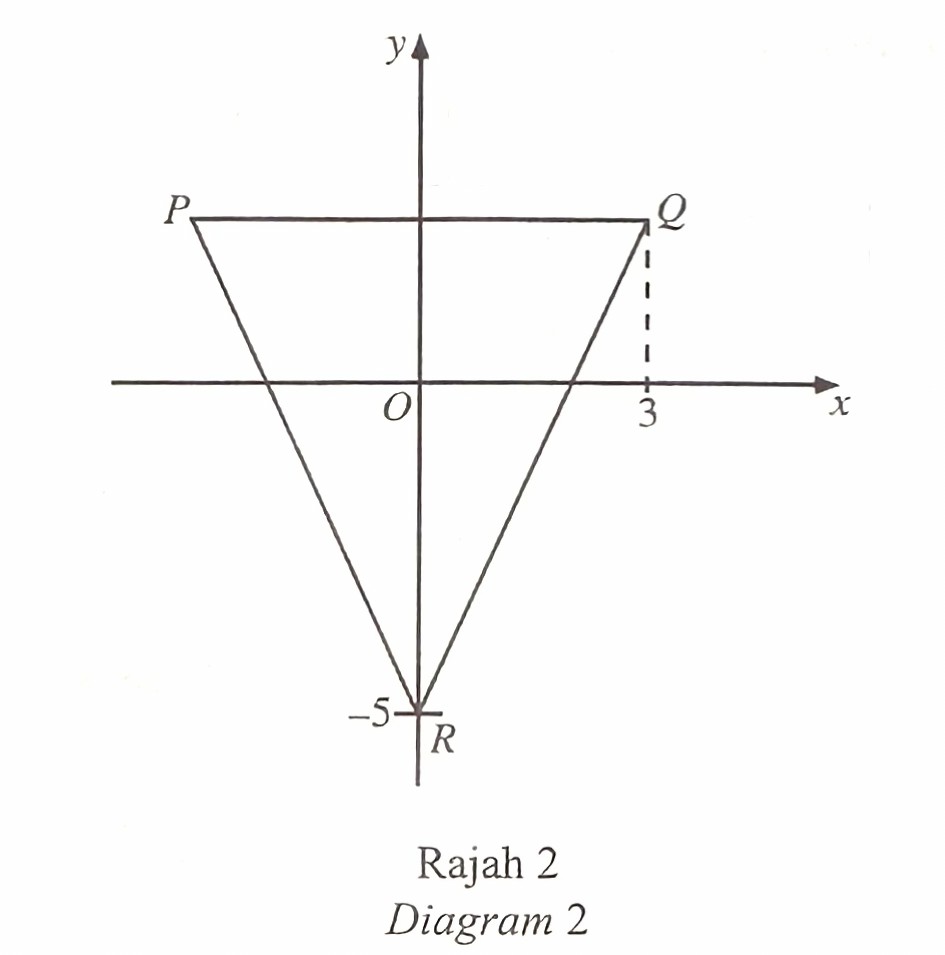
Find the coordinates of P.
$$ \begin{aligned} &\text { A }(-4,2)\\ &\text { B (-4, 3) }\\ &\text { C (-3, 2) }\\ &\text { D }(-3,3) \end{aligned} $$
Solution:
Answer : C
$$ \begin{aligned} &\ x \text {-coordinate }\\ &=-3 \end{aligned} $$
$$ \begin{aligned} &\ y \text {-coordinate }\\ &\begin{aligned} & =7-5 \\ & =2 \end{aligned} \end{aligned} $$
$$ \begin{aligned} &\text { Coordinates of } P\\ &=(-3,2) \end{aligned} $$
Diagram 2 shows an isosceles triangle PQR. The height of triangle PQR is 7 units. PQ is parallel to the x-axis.
Find the coordinates of P.
$$ \begin{aligned} &\text { A }(-4,2)\\ &\text { B (-4, 3) }\\ &\text { C (-3, 2) }\\ &\text { D }(-3,3) \end{aligned} $$
Solution:
Answer : C
$$ \begin{aligned} &\ x \text {-coordinate }\\ &=-3 \end{aligned} $$
$$ \begin{aligned} &\ y \text {-coordinate }\\ &\begin{aligned} & =7-5 \\ & =2 \end{aligned} \end{aligned} $$
$$ \begin{aligned} &\text { Coordinates of } P\\ &=(-3,2) \end{aligned} $$
Question 12:
Diagram 3 shows two straight lines, JK and LM, on a Cartesian plane, JK intersects LM at point T.
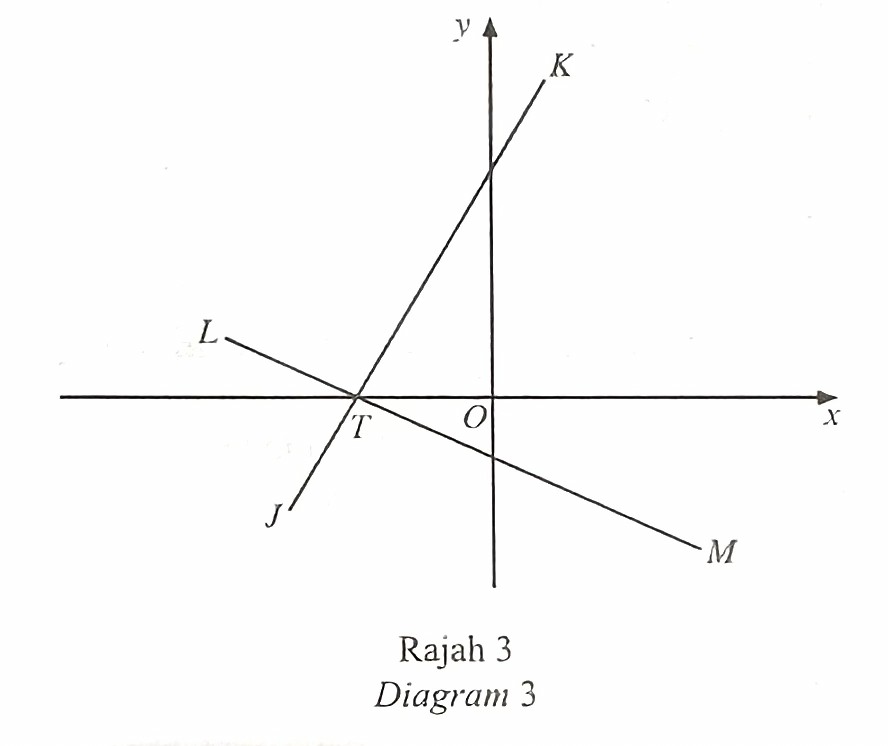 Given that the equation of JK is 2y – 5x – 7 = 0, find the x-intercept of LM.
A -7
B -5
C -7/2
D -7/5
Solution:
Answer : D
$$ \begin{aligned} &\begin{aligned} 2 y-5 x-7 & =0 \\ 2(0)-5 x-7 & =0 \\ -5 x & =7 \\ x & =-\frac{7}{5} \end{aligned}\\ & x\text {-intercept }=-\frac{7}{5} \end{aligned} $$
Diagram 3 shows two straight lines, JK and LM, on a Cartesian plane, JK intersects LM at point T.
Given that the equation of JK is 2y – 5x – 7 = 0, find the x-intercept of LM.A -7
B -5
C -7/2
D -7/5
Solution:
Answer : D
$$ \begin{aligned} &\begin{aligned} 2 y-5 x-7 & =0 \\ 2(0)-5 x-7 & =0 \\ -5 x & =7 \\ x & =-\frac{7}{5} \end{aligned}\\ & x\text {-intercept }=-\frac{7}{5} \end{aligned} $$
Question 13:
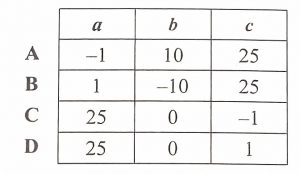
The general form of a quadratic expression is ax2 + bx + c.
Determine the value of a, of b and of c for (5 – x)2.
Solution:
Answer : B
$$ \begin{aligned} (5-x)^2 & =25-10 x+x^2 \\ & =c+b x+a x^2 \\ a=1, b & =-10, c=25 \end{aligned} $$
The general form of a quadratic expression is ax2 + bx + c.
Determine the value of a, of b and of c for (5 – x)2.
Solution:
Answer : B
$$ \begin{aligned} (5-x)^2 & =25-10 x+x^2 \\ & =c+b x+a x^2 \\ a=1, b & =-10, c=25 \end{aligned} $$
Question 14:
Diagram 4 shows a parallelogram with an area of 360 cm2.
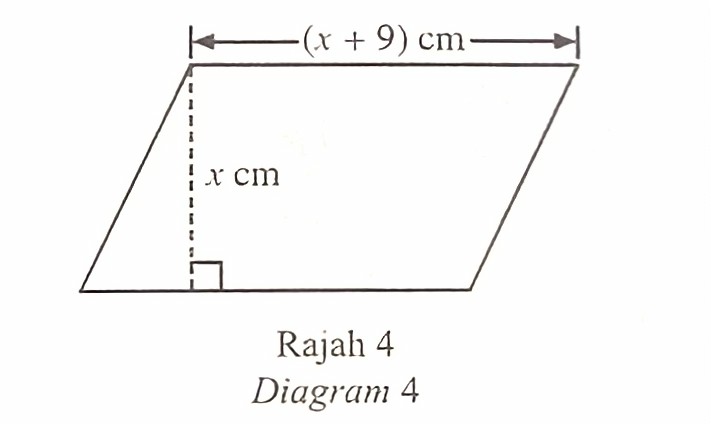 Find the value of x.
A 15
B 24
C 30
D 40
Solution:
Answer : A
$$ \begin{aligned} &\text { Area of parallelogram }=x(x+9)\\ &\begin{aligned} 360 & =x(x+9) \\ 360 & =x^2+9 x \\ x^2+9 x-360 & =0 \\ (x-15)(x+24) & =0 \end{aligned}\\ &\begin{aligned} & x=15 \mathrm{or} x=-24 \\ & \therefore x=15 \end{aligned} \end{aligned} $$
Diagram 4 shows a parallelogram with an area of 360 cm2.
Find the value of x.A 15
B 24
C 30
D 40
Solution:
Answer : A
$$ \begin{aligned} &\text { Area of parallelogram }=x(x+9)\\ &\begin{aligned} 360 & =x(x+9) \\ 360 & =x^2+9 x \\ x^2+9 x-360 & =0 \\ (x-15)(x+24) & =0 \end{aligned}\\ &\begin{aligned} & x=15 \mathrm{or} x=-24 \\ & \therefore x=15 \end{aligned} \end{aligned} $$
Question 15:
John sells two types of potted flowers. He sells x pots of hibiscus for RM16.50 each pot and y pots of roses for RM18 each pot. The total daily sales must be at least RM360 in order to make profit.
Which of the following linear inequalities represents the situation?
$$ \begin{aligned} &\text { A } \frac{33}{2} x+18 y \geqslant 360\\ &\text { B } \frac{33}{2} x+18 y \leqslant 360\\ &\text { C } \frac{33}{2} x+18 y>360\\ &\text { D } \frac{33}{2} x+18 y<360 \end{aligned} $$
Solution:
Answer : A
$$ \begin{array}{ll} 16.5 x+18 y \geqslant 360 \\ \frac{33}{2} x+18 y \geqslant 360 \end{array} $$
John sells two types of potted flowers. He sells x pots of hibiscus for RM16.50 each pot and y pots of roses for RM18 each pot. The total daily sales must be at least RM360 in order to make profit.
Which of the following linear inequalities represents the situation?
$$ \begin{aligned} &\text { A } \frac{33}{2} x+18 y \geqslant 360\\ &\text { B } \frac{33}{2} x+18 y \leqslant 360\\ &\text { C } \frac{33}{2} x+18 y>360\\ &\text { D } \frac{33}{2} x+18 y<360 \end{aligned} $$
Solution:
Answer : A
$$ \begin{array}{ll} 16.5 x+18 y \geqslant 360 \\ \frac{33}{2} x+18 y \geqslant 360 \end{array} $$