Question 17:
Diagram 6 shows the speed-time graph of two runners. Graph OP represents Ahmad’s run and graph OQ represents Goh’s run.
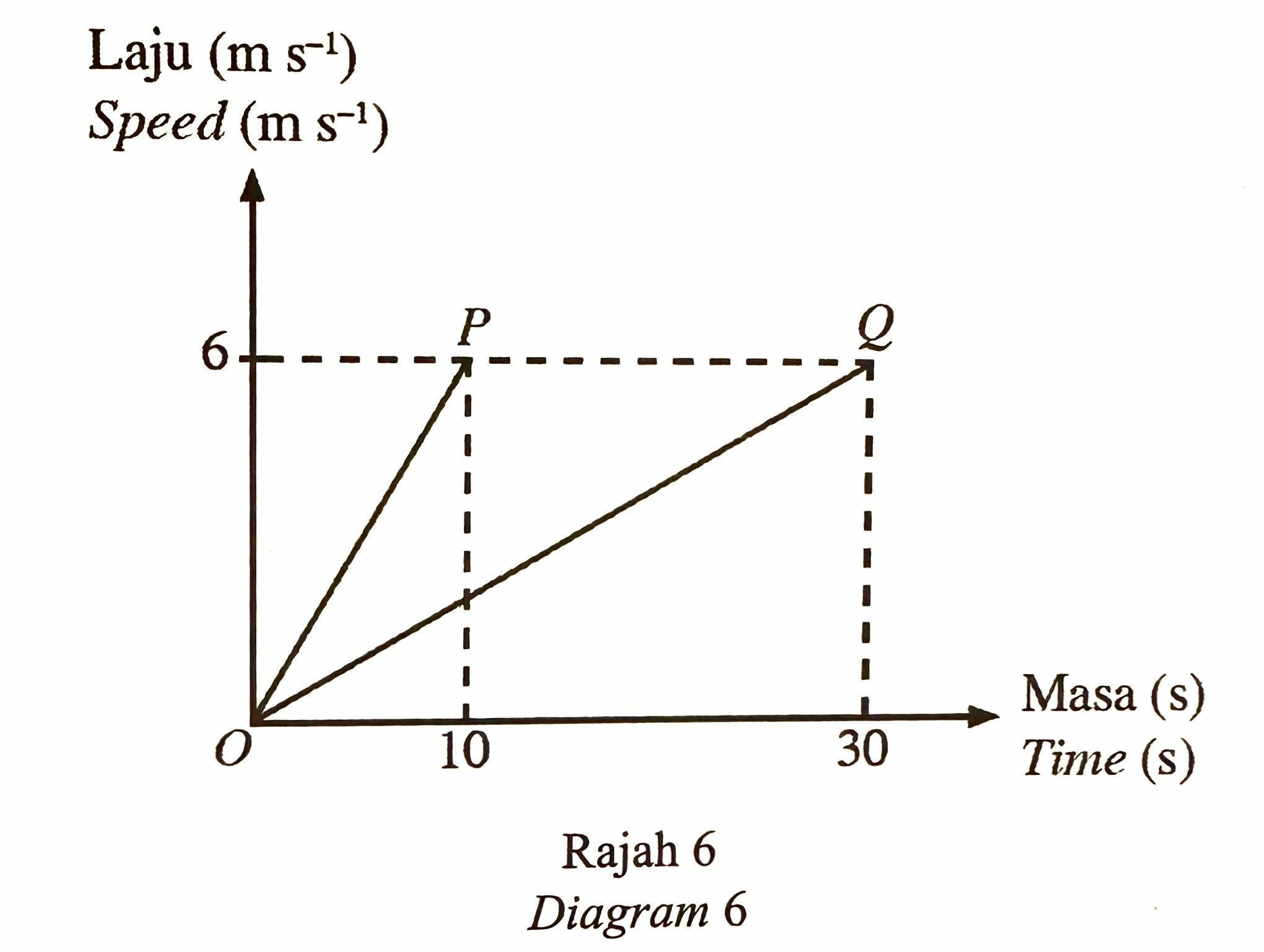
Calculate the difference between the accelerations, in m s-2, of their runs.
A 0.2
B 0.3
C 0.4
D 0.6
Solution:
Answer : C
$$ \begin{aligned} &\text { Ahmad’s run acceleration }\\ &\begin{aligned} & =\frac{6 \mathrm{~m} \mathrm{~s}^{-1}}{10 \mathrm{~s}} \\ & =0.6 \mathrm{~m} \mathrm{~s}^{-2} \end{aligned} \end{aligned} $$
$$ \begin{aligned} \text { Goh’s run acceleration } & =\frac{6 \mathrm{~m} \mathrm{~s}^{-1}}{30 \mathrm{~s}} \\ & =0.2 \mathrm{~m} \mathrm{~s}^{-2} \end{aligned} $$
$$ \begin{aligned} &\text { Difference between the accelerations }\\ &\begin{aligned} & =0.6 \mathrm{~m} \mathrm{~s}^{-2}-0.2 \mathrm{~m} \mathrm{~s}^{-2} \\ & =0.4 \mathrm{~m} \mathrm{~s}^{-2} \end{aligned} \end{aligned} $$
Diagram 6 shows the speed-time graph of two runners. Graph OP represents Ahmad’s run and graph OQ represents Goh’s run.
Calculate the difference between the accelerations, in m s-2, of their runs.
A 0.2
B 0.3
C 0.4
D 0.6
Solution:
Answer : C
$$ \begin{aligned} &\text { Ahmad’s run acceleration }\\ &\begin{aligned} & =\frac{6 \mathrm{~m} \mathrm{~s}^{-1}}{10 \mathrm{~s}} \\ & =0.6 \mathrm{~m} \mathrm{~s}^{-2} \end{aligned} \end{aligned} $$
$$ \begin{aligned} \text { Goh’s run acceleration } & =\frac{6 \mathrm{~m} \mathrm{~s}^{-1}}{30 \mathrm{~s}} \\ & =0.2 \mathrm{~m} \mathrm{~s}^{-2} \end{aligned} $$
$$ \begin{aligned} &\text { Difference between the accelerations }\\ &\begin{aligned} & =0.6 \mathrm{~m} \mathrm{~s}^{-2}-0.2 \mathrm{~m} \mathrm{~s}^{-2} \\ & =0.4 \mathrm{~m} \mathrm{~s}^{-2} \end{aligned} \end{aligned} $$
Question 18:
$$ \text { It is given that } m\left[\begin{array}{l} n \\ 8 \end{array}\right]=\left[\begin{array}{c} 20 \\ -40 \end{array}\right] $$
$$ \text { Find the value of } m \text { and of } n \text {. } $$
$$ \begin{aligned} &\text { A } m=-5, n=-4\\ &\text { B } m=-5, n=4\\ &\text { C } m=-4, n=-5\\ &\text { D } m=-4, n=5 \end{aligned} $$
Solution:
Answer : A
$$ \begin{aligned} m\left[\begin{array}{l} n \\ 8 \end{array}\right] & =\left[\begin{array}{c} 20 \\ -40 \end{array}\right] \\ m(8) & =-40 \\ m & =-\frac{40}{8} \\ m & =-5 \end{aligned} $$
$$ \begin{aligned} m n & =20 \\ (-5) n & =20 \\ n & =-\frac{20}{5} \\ n & =-4 \end{aligned} $$
$$ \text { It is given that } m\left[\begin{array}{l} n \\ 8 \end{array}\right]=\left[\begin{array}{c} 20 \\ -40 \end{array}\right] $$
$$ \text { Find the value of } m \text { and of } n \text {. } $$
$$ \begin{aligned} &\text { A } m=-5, n=-4\\ &\text { B } m=-5, n=4\\ &\text { C } m=-4, n=-5\\ &\text { D } m=-4, n=5 \end{aligned} $$
Solution:
Answer : A
$$ \begin{aligned} m\left[\begin{array}{l} n \\ 8 \end{array}\right] & =\left[\begin{array}{c} 20 \\ -40 \end{array}\right] \\ m(8) & =-40 \\ m & =-\frac{40}{8} \\ m & =-5 \end{aligned} $$
$$ \begin{aligned} m n & =20 \\ (-5) n & =20 \\ n & =-\frac{20}{5} \\ n & =-4 \end{aligned} $$
Question 19:
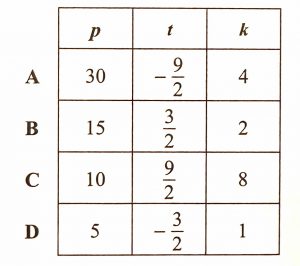
$$ \text { Given that } 3\left[\begin{array}{lll} -1 & 2 & 5 \end{array}\right]-\frac{1}{2}\left[\begin{array}{lll} 3 & 4 & p \end{array}\right]=\left[\begin{array}{lll} t & k & 0 \end{array}\right] \text {, } $$
$$ \text { find the value of } p \text {, of } t \text { and of } k \text {. } $$
Solution:
Answer : A
$$ \begin{aligned} & 3\left[\begin{array}{lll} -1 & 2 & 5 \end{array}\right]-\frac{1}{2}\left[\begin{array}{lll} 3 & 4 & p \end{array}\right]=\left[\begin{array}{lll} t & k & 0 \end{array}\right] \\ & {\left[\begin{array}{lll} -3 & 6 & 15 \end{array}\right]-\left[\begin{array}{lll} \frac{3}{2} & \frac{4}{2} & \frac{p}{2} \end{array}\right]=\left[\begin{array}{lll} t & k & 0 \end{array}\right]} \end{aligned} $$
$$ \begin{aligned} -3-\frac{3}{2} & =t \\ t & =-\frac{9}{2} \end{aligned} $$
$$ \begin{aligned} 6-\frac{4}{2} & =k \\ k & =4 \end{aligned} $$
$$ \begin{aligned} 15-\frac{p}{2} & =0 \\ 15 & =\frac{p}{2} \\ p & =30 \end{aligned} $$
$$ \text { Given that } 3\left[\begin{array}{lll} -1 & 2 & 5 \end{array}\right]-\frac{1}{2}\left[\begin{array}{lll} 3 & 4 & p \end{array}\right]=\left[\begin{array}{lll} t & k & 0 \end{array}\right] \text {, } $$
$$ \text { find the value of } p \text {, of } t \text { and of } k \text {. } $$
Solution:
Answer : A
$$ \begin{aligned} & 3\left[\begin{array}{lll} -1 & 2 & 5 \end{array}\right]-\frac{1}{2}\left[\begin{array}{lll} 3 & 4 & p \end{array}\right]=\left[\begin{array}{lll} t & k & 0 \end{array}\right] \\ & {\left[\begin{array}{lll} -3 & 6 & 15 \end{array}\right]-\left[\begin{array}{lll} \frac{3}{2} & \frac{4}{2} & \frac{p}{2} \end{array}\right]=\left[\begin{array}{lll} t & k & 0 \end{array}\right]} \end{aligned} $$
$$ \begin{aligned} -3-\frac{3}{2} & =t \\ t & =-\frac{9}{2} \end{aligned} $$
$$ \begin{aligned} 6-\frac{4}{2} & =k \\ k & =4 \end{aligned} $$
$$ \begin{aligned} 15-\frac{p}{2} & =0 \\ 15 & =\frac{p}{2} \\ p & =30 \end{aligned} $$
Question 20:
It is given that p varies inversely as square of w and p = 3 when w = 2.
Find the relation between p and w.
$$ \begin{aligned} &\text { A } p=12 w\\ &\text { B } p=\frac{12}{w^2}\\ &\text { C } p=\frac{3}{4} w^2\\ &\text { D } p=\frac{3}{4 w^2} \end{aligned} $$
Solution:
Answer : B
$$ \begin{aligned} & p ∝ \frac{1}{w^2} \\ & p=\frac{k}{w^2} \\ & 3=\frac{k}{2^2} \\ & k=3 \times 2^2 \\ & k=12 \\ & p=\frac{12}{w^2} \end{aligned} $$
It is given that p varies inversely as square of w and p = 3 when w = 2.
Find the relation between p and w.
$$ \begin{aligned} &\text { A } p=12 w\\ &\text { B } p=\frac{12}{w^2}\\ &\text { C } p=\frac{3}{4} w^2\\ &\text { D } p=\frac{3}{4 w^2} \end{aligned} $$
Solution:
Answer : B
$$ \begin{aligned} & p ∝ \frac{1}{w^2} \\ & p=\frac{k}{w^2} \\ & 3=\frac{k}{2^2} \\ & k=3 \times 2^2 \\ & k=12 \\ & p=\frac{12}{w^2} \end{aligned} $$
Question 21:
Table 5 shows some values of the variables R, S and T.
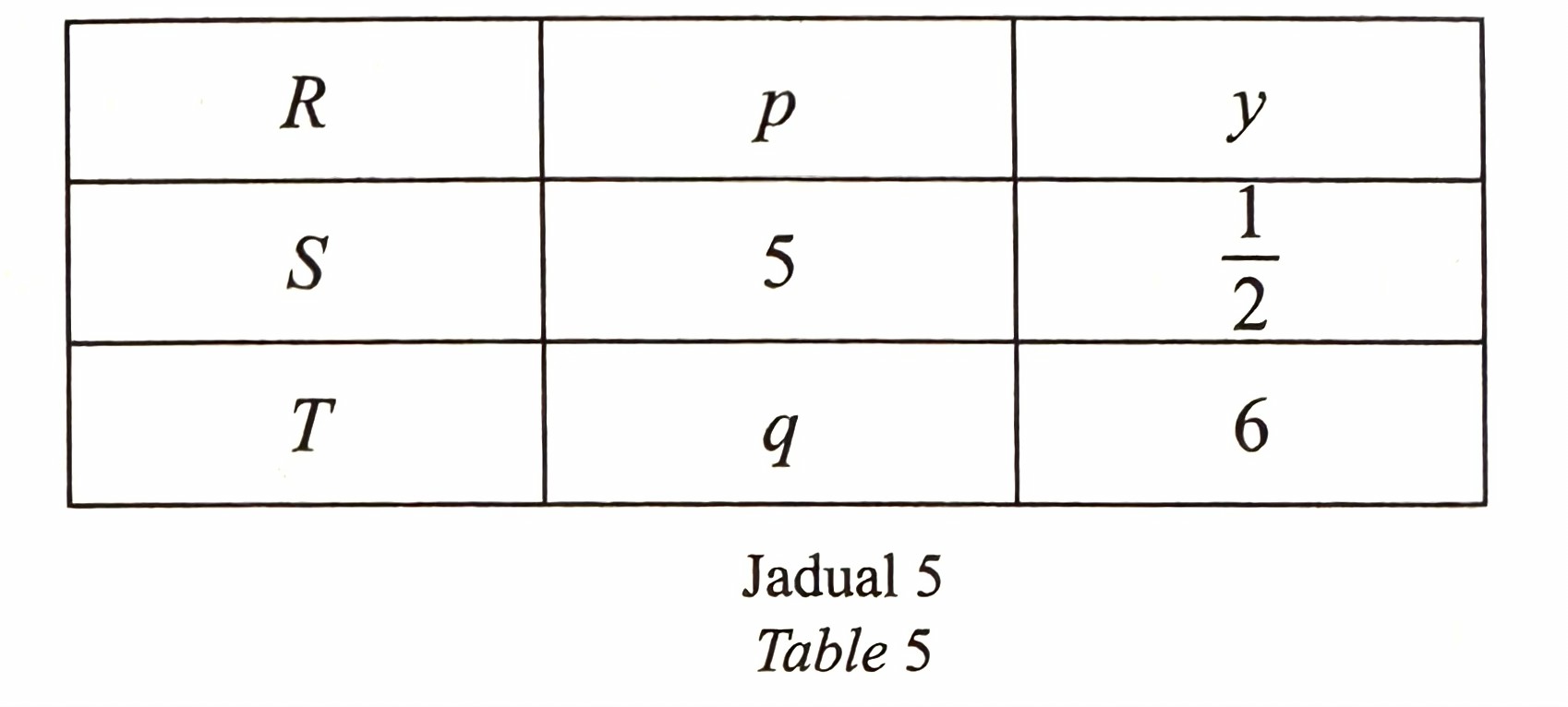 It is given that R varies directly as S and varies inversely as T.
Calculate the value of y when p × q = 20.
$$ \begin{aligned} &\text { A } \frac{1}{48}\\ &\text { B } \frac{1}{3}\\ &\text { C } 3\\ &\text { D } 48 \end{aligned} $$
Solution:
Answer : B
$$ \begin{aligned} R ∝ \frac{S}{T} \\ p & =\frac{k S}{T} \\ p & =\frac{k(5)}{q} \\ p \times q & =5 k \\ 20 & =5 k \\ k & =\frac{20}{5} \\ k & =4 \end{aligned} $$
$$ \begin{aligned} y & =\frac{4\left(\frac{1}{2}\right)}{6} \\ y & =\frac{1}{3} \end{aligned} $$
Table 5 shows some values of the variables R, S and T.
It is given that R varies directly as S and varies inversely as T.Calculate the value of y when p × q = 20.
$$ \begin{aligned} &\text { A } \frac{1}{48}\\ &\text { B } \frac{1}{3}\\ &\text { C } 3\\ &\text { D } 48 \end{aligned} $$
Solution:
Answer : B
$$ \begin{aligned} R ∝ \frac{S}{T} \\ p & =\frac{k S}{T} \\ p & =\frac{k(5)}{q} \\ p \times q & =5 k \\ 20 & =5 k \\ k & =\frac{20}{5} \\ k & =4 \end{aligned} $$
$$ \begin{aligned} y & =\frac{4\left(\frac{1}{2}\right)}{6} \\ y & =\frac{1}{3} \end{aligned} $$
Question 22:
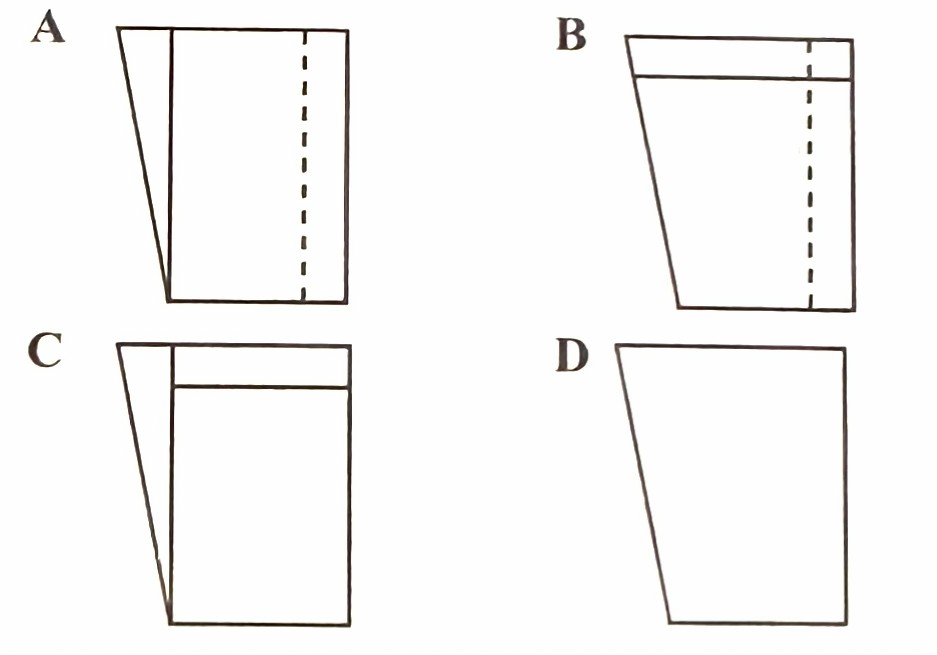
Diagram 7 shows a prism which lies on a horizontal plane. RSTW is the uniform cross-section of the prism.
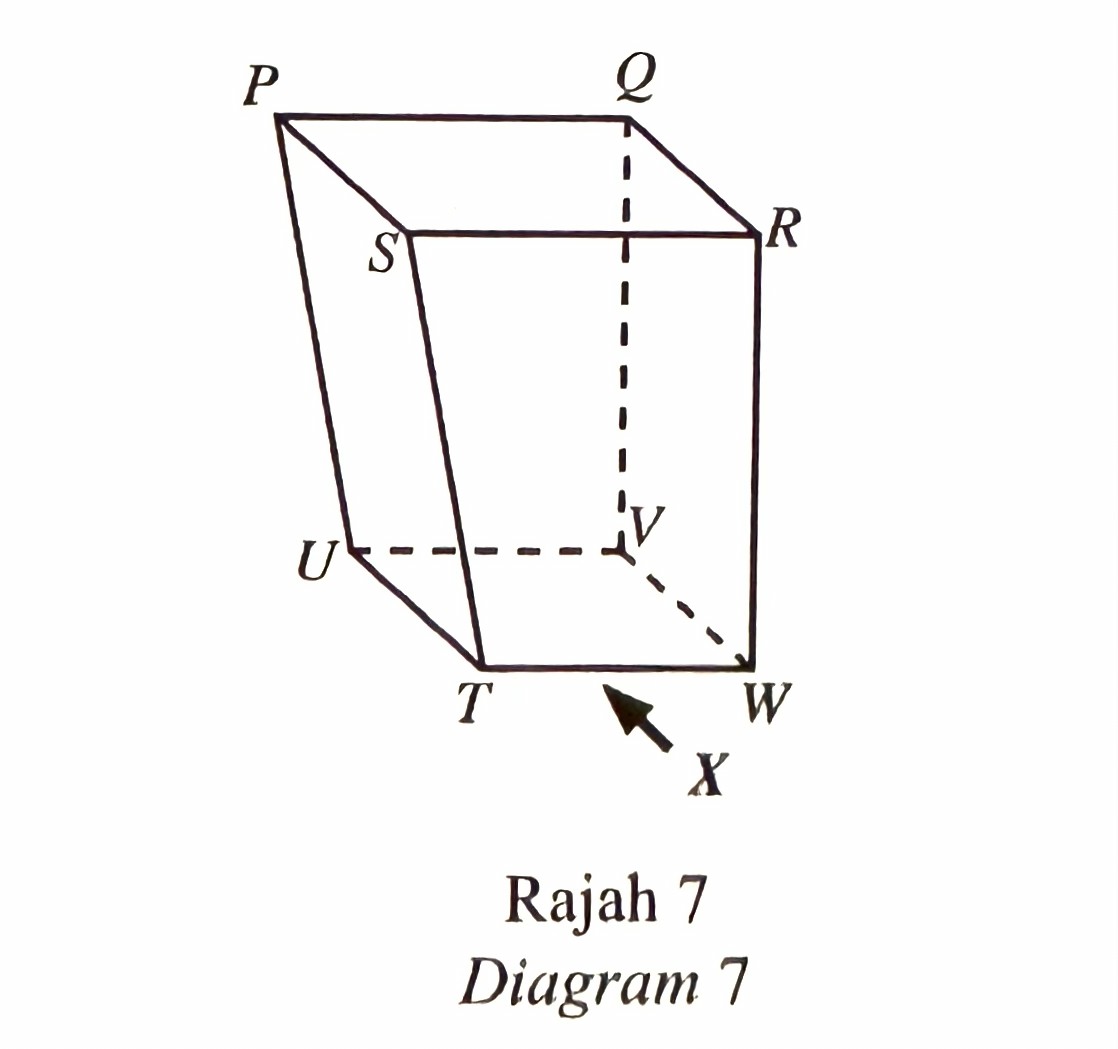
Which of the following is the correct orthogonal projection as viewed from X?
Solution:
Answer : D
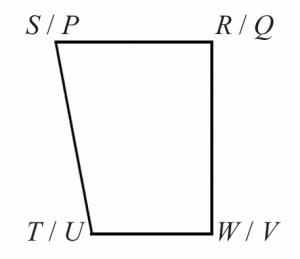
Diagram 7 shows a prism which lies on a horizontal plane. RSTW is the uniform cross-section of the prism.
Which of the following is the correct orthogonal projection as viewed from X?
Solution:
Answer : D